
Last update: January 2026
This page contains information about some of the data available in the FEWS NET Data Explorer (FDE) for Egypt. This is not a comprehensive guide.
For information about using the filters and fields for specific topics in the FDE, see Explore Data.
Summary table
|
ISO 3166-1 codes |
Alpha 2: EG, Alpha 3: EGY, Numeric: 818 |
|---|---|
|
Administrative units |
Governorate, Markaz, District and Village |
|
Agricultural seasons |
Winter, summer, nili |
|
Major crops |
Wheat, barley, maize, vegetables |
Acknowledgements
The Egyptian crop dataset found in the FEWS NET Data Warehouse, and this Country Data Book publication are a joint effort of the United States Department of State-funded Famine Early Warning Systems Network (FEWS NET), the International Food Policy Research Institute (IFPRI) and the Joint Research Centers (JRC) of the European Union-managed HarvestStat Middle East/North Africa (MENA). HarvestStat MENA provides datasets of subnational crop data for 20 countries across the Middle East and North Africa in formats that are interoperable with the FEWS Data Warehouse and ready for academic analysis. For additional information, please refer to the HarvestStat vision paper and the FEWS Data Explorer Knowledge Base.
Country food security context
Egypt’s agronomic issues are a major cause of its food insecurity… Due to the growing threat of changing weather patterns, Egypt is experiencing chronic desertification and land degeneration. According to a United Nations report from November 2024, “around 100 million hectares…of healthy and productive land is being degraded each year due to drought and desertification.” This scale of land degeneration is especially critical in Egypt considering the already limited nature of its farmland. Only around 4% of Egypt’s land is fit for agriculture, with the rest of the country being deserted and secluded from its main irrigation method, the Nile.
The drought brought on by the changing climate, coupled with a growing population, also means that Egypt experiences severe water scarcity. Not only does this water scarcity impact its irrigation, and thus Egypt’s food system, but its poor irrigation methods also impact its water scarcity. The country already uses approximately 90% of the Nile water for its agricultural system, meaning only 10% is available as drinking water for its population. The low efficiency of these agricultural systems and the increasing demand for water means that since the 1970s, Egypt has had to import water and food to make up for its scarcity. This reliance on importing water and food presents a huge financial burden on the country and also makes it more vulnerable to external shifts.
Egypt’s reliance on imports has everything to do with its food subsidies. More than 60 of the 105 million citizens depend on Egypt’s subsidized food system for sugar, pasta, and most importantly, bread. Bread is the main source of subsidized nutrition for the large majority of Egypt’s population, which consumes double as much as the country can produce. With wheat being one of the most water-intensive crops and Egypt’s lack of water, the country has become the largest importer of wheat in the world…
As the World Bank Group puts it, “Egyptians seem to perceive food subsidies as the most concrete benefit they receive from government spending. Seen as an entitlement, food subsidies are politically sensitive.” This history of bread in the country puts further pressure on Egypt when making changes to its agriculture, imports or subsidies.
From Egypt’s Food System: A Possible Shift in Subsidies for 2025.
Statistical reporting units
Egypt usually uses administrative units as their statistical reporting units.
Administrative (admin) units are the geographical areas into which a country is divided. FEWS NET uses the following terminology: National boundary = admin 0, First sub-national division = admin 1 (e.g., states in the United States), Second sub-national division = admin 2 (e.g., counties in the United States), and so on.
Admin 1: Governorate (muhafaza) (27 total)
Admin 2: Marakaz and qism/kism (>350 total)
Admin 3: Districts (urban) and villages (rural)
Since 1980, Egypt’s administrative structures have remained relatively unchanged. The first sub-national level of administrative units into which Egypt is divided includes 27 governorates (muhafaza), of which three are entirely urban in nature.
Below them are found second-level counties referred to as marakaz or qism/kism, which totalled 351 in 2013. At the third-level are found districts and villages. These administrative units are generally used as statistical reporting units as well.
Evolution of administrative reporting units
There have only been 3 changes to the boundaries of the governorates (admin 1 level) since 1980:
-
2008: Cairo and Giza governorates were split to create two new governorates, Helwan and 6th of October, respectively.
-
2011: The two governorates created in 2008 were re-incorporated into the governorates they came from.
-
2009: The governorate of Luxor was created by splitting Qena Governorate, a change that has remained.
Crop data
Explore our crop data.
Egypt's agricultural land is limited to the Nile Valley and delta, with a few oases and arable land in Sinai. The total cultivated area is 7.2 million acres (1 acre equals 0.42 ha), accounting for only 3% of the total land area. Except for some rain-fed areas on the Mediterranean coast, the entire crop area is irrigated. In addition, 900,000 acres of newly reclaimed land have been added to the agricultural area over the last four decades. The landholdings are dispersed, with farm units averaging in size about 2.5 acres. The total area cropped annually is approximately 11.5 million acres… Egypt's total agricultural crop production has increased by more than 20 percent in the past decade. During the same period, the rate of population growth has increased at a slightly higher rate than the increase in crop production.”
From FAO
Crop estimate data sources
The Egyptian Ministry of Agriculture and Land Reclamation (وزارة الزراعة واستصلاح الأراضي; MALR) is the main governmental authority for agricultural statistics. Its Economic Affairs Sector is responsible for developing and updating the data used to shape national agricultural policies. Outside the Ministry, both the provincial Agricultural Directorates and the Agricultural Research Center (ARC): Agricultural Production Estimation Research Department by Samples unit (قسم بحوث تقديرات الإنتاج الزراعى بالعينات) assist in undertaking annual assessments of agriculture.
The Central Agency for Public Mobilization and Statistics (CAPMAS - الجهاز المركزي للتعبئة العامة والإحصاء) is the official statistical agency of Egypt. CAPMAS was established by a Presidential Decree 2915 in 1964 and is the provider of official national data, statistics, and reports.
CAPMAS processes, analyzes, and publishes agricultural statistics data it receives from the MALR in an annual series of publications referred to as the “Annual Bulletin of Statistical Crop Area and Plant Production <year>” which has been published since before 1990.
All CAPMAS sub-national crop statistics are found through the website’s menus at Releases → Annual publications, in annual editions of a document series entitled “Crop Areas and Productions”.
Note an issue with this historic archive: In the 1990s and the 2000s, these reports were apparently intended to contain all three crop season statistics (Summer, Nili and Winter). Nevertheless, some of the annual reports do not contain Winter crop data, and some reports only include area planted data, without production data. We are attempting to locate missing data from both of these decades.
Crop statistics reporting units
For Egypt’s crop statistics, the FDW uses an alternate crop region set of statistical reporting units. This allows for integration of governate and non-governorate-based crop reporting from a new irrigated western-desert agricultural scheme called Noubaria. Noubaria is located adjacent to and within areas that nominally belong to four other governorates (Behera, Minoufia, Giza and Alexandria), but reports its agricultural estimates separately from those.
Year and season definition
Year definitions
The annual cropping cycle in Egypt is generally conceived to run between April 1 and March 31 of the next year.
Despite this, the country’s annual crop production reporting covers crops harvested between January 1 and December 31, therefore reflecting almost all of the production that is planted and harvested in annual Winter-Summer-Nili cropping cycle. This annual reporting year is generally referred to with a one year notation (e.g. 2023).
Example: The cropping cycle that started on November 1, 2022 was mostly harvested between January 1 and December 1, 2023. This reporting year is referred to as 2023.
Seasons
Modern agriculture in Egypt utilizes these three seasons with irrigation, enabling higher cropping intensity than the ancient, flood-dependent single annual cycle:
-
Summer cropping season (April/May–October): Summer is especially important for cotton, rice, sugarcane and maize. Rice is concentrated in the Delta, and sugarcane is a key crop in Middle and Upper Egypt.
-
Nili cropping season (July/August–October): Nili is historically linked to a low water or fallow period. This season is more about the transition between major planting cycles in modern, irrigated systems, though it's less distinct in modern irrigation-dependent farming.
-
Winter cropping season (November–June): A crucial season for growing essential food and fodder crops like wheat, barley, clover (berseem), and sugar beet.
Crop Calendar
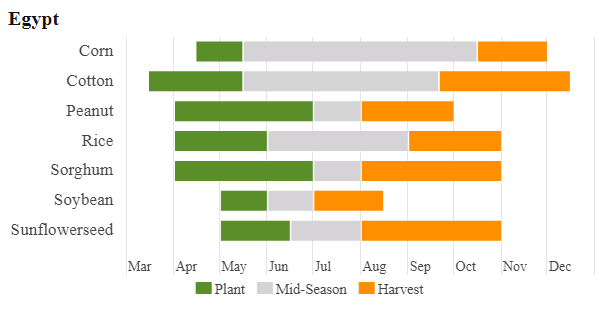
The Foreign Agriculture Service of USDA makes available crop calendars for major cropping seasons worldwide. Here we reproduce crop calendars for the major crops in Summer and Winter.
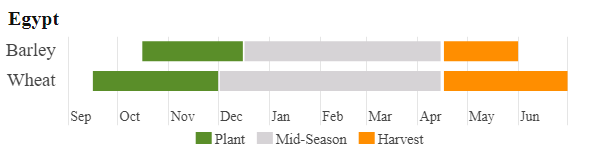
Barley is planted October to December and harvested in April and May.
Wheat is planted September to November and harvested April to June.
Crop statistics context
In Egypt, crop area measurements are most often given in feddan which is roughly 0.420 hectares, or 1.037 acres. Crop production is often given in either quintals, or metric tonnes. In Egypt, 1 quintal = 100 kilograms.
Especially in the context of Egyptian agronomic research and publications, it is not unusual to see an old unit of dry measure, the ardab (ardeb), being used. Although it may be defined as equivalent to approximately 5.619 U.S. bushels or 198 liters, the term actually reflects different quantities depending upon which country and crop is being discussed. The table below lists the equivalence of an ardab in kilograms in Egypt.
Table 1: Ardab to kilogram conversion
|
Crop |
Ardab in kilograms |
|---|---|
|
Barley |
120 |
|
Chickpea |
150 |
|
Clover |
175 |
|
Cotton seed |
120 |
|
Fenugreek |
155 |
|
Flax seed |
122 |
|
Groundnut |
75 |
|
Lentils |
160 |
|
Lupin |
150 |
|
Maize |
140 |
|
Onion |
45 |
|
Pea, dry |
160 |
|
Safflower |
113 |
|
Sesame |
120 |
|
Sorghum |
140 |
|
Wheat |
150 |
For cotton and sugar cane production, Egypt uses a kantar/quintar, related to the centnar used in other countries. It originated from the Ancient Greek term for hundredweight and served as a significant measure in the Mediterranean region and Egypt for centuries. The table below lists the equivalence of a quintar in kilograms in Egypt.
Table 2: Quintar to kilogram conversion
|
Crop |
Quintar in kilograms |
|---|---|
|
Cotton |
157.5 |
|
Lint cotton |
50 |
|
Sugar cane |
45 |
For straw production, one may occasionally encounter a measure called a heml which is equivalent to approximately 250 kilograms.
For the luffa crop, a measure called a koz is used, which is equivalent to 1,000 ounces, or approximately 28.35 kilograms.
Crop Production Systems
Egypt’s agricultural land area is about 3.2 million ha, covering three different production zones and farming systems:
-
Old irrigated lands (Old Lands): An area of 2.3 million ha, lying in the Nile Valley and Delta, representing the most fertile soils in Egypt.
-
Newly reclaimed lands (New Lands): A potential area of 0.8 million ha, which include the newly reclaimed desert lands of sandy and calcareous origin, where soil is poor in organic matter and in macro- and micronutrients.
-
Rain-fed areas: Although not mentioned in official crop reporting, there are a number of rain-fed agricultural areas, about 0.1 million ha of sandy soil, located in the Northwest Coast and North Sinai areas.
Crops
The names used for specific crops, and the types of crops reported in source documents varies over the years.
In source reporting, the MALR provides area planted and production data for an extensive list of white and yellow maize cultivars. Note that yellow maize is synonymous with corn in Egyptian crop reporting. The word “green” attached to a crop name indicates a fresh or not fully-mature variety of that crop, as in green maize, green kidney bean, green onion, and green broad bean. Source crop reporting often provides crop statistics for multiple types of fodders (principally clover/barseem, clover/tahreesh, and alfalfa, as well as green fodder which incorporates other crops not specifically reported). Egyptian crop statistics report on a large number of grains, vegetables, fruits, fodders, and other specialty crops. The major ones are listed in the table below with their FEWS NET CPCv2 codes.nsive list of white and yellow maize cultivars. Note that yellow maize is synonymous with corn in Egyptian crop reporting. The word green attached to a crop name indicates a fresh or not fully-mature variety of that crop, as in green maize, green kidney bean, green onion, and green broad bean. Source crop reporting often provides crop statistics for multiple types of fodders (principally clover/barseem, clover/tahreesh, and alfalfa, as well as green fodder which incorporates other crops not specifically reported).
Egyptian crop statistics report on a large number of grains, vegetables, fruits, fodders, and other specialty crops. The major ones are listed in the table below with their FEWS NET CPCv2 codes.
|
Crop (English) |
Crop (Arabic) |
Crop Code |
|---|---|---|
|
Wheat |
القمح |
R01112AA |
|
Maize |
الذرة الشامية |
R01122AA |
|
Rice |
الأرز |
R01132AA |
|
Sorghum |
الذرة الرفيعة |
R01142AA |
|
Barley |
لشعير |
R01152AA |
|
Cereal crop |
محصول الحبوب |
R01190XX |
|
Watermelon |
البطيخ |
R01221AA |
|
Cucumber |
الخيار |
R01232AA |
|
Tomatoes |
الطماطم |
R01234AA |
|
Luffa |
اللوف |
R01235AG |
|
Garlic |
الثوم |
R01252AA |
|
Bulb onion |
البصل (كامل النضج) |
R01253AA |
|
Green onion |
البصل الأخضر |
R01253AH |
|
Vegetables |
الخضر الأساسية |
R01290AA |
|
Banana |
الموز |
R01312AA |
|
Soybeans |
الفول الصوي |
R01412AA |
|
Groundnut |
الفول السودان |
R01422AA |
|
Flax |
الكتان |
R01441AA |
|
Sesame |
لسمسم |
R01444AA |
|
Sunflower |
عباد الشمس |
R01445AA |
|
Potato |
البطاطس |
R01510AA |
|
Broad bean |
الفول |
R01702AA |
|
Fenugreek |
ا لبة |
R01702AD |
|
Chickpea |
ا مص |
R01703AA |
|
Lentils |
لعدس |
R01704AA |
|
Peas |
البسلة |
R01705AA |
|
Lupin |
الترمس |
R01709AH |
|
Legume crop |
محصول البقوليات |
R01709XX |
|
Sugarcane |
قصب السكر |
R01801AA |
|
Sugar beets |
بنجر السكر |
R01801AA |
|
Alfalfa |
البرسيم ا جازي |
R01912AA |
|
Clover |
لبرسيم المستدي |
R01919AA |
|
Clover tahreesh |
البرسيم التحريش |
R01919AC |
|
Fodder |
الأعلاف |
R01919XX |
|
Green fodder |
الأعلاف ا ضراء |
R01919XY |
|
Cotton |
القطن |
R01921AA |