
Last update: December 2025
This page contains information about some of the data available in the FEWS NET Data Explorer (FDE) for Chile. This is not a comprehensive guide.
For information about using the filters and fields for specific topics in the FDE, see Explore Data.
Summary table
|
ISO 3166-1 codes |
Alpha 2: CL, Alpha 3: CHL, Numeric: 152 |
|---|---|
|
Administrative units |
Provinces, departments |
|
Agricultural seasons |
Winter, summer |
|
Major crops |
Maize, wheat, barley, sunflower seed, beans |
Acknowledgements
The Chile crop dataset found in the FEWS NET Data Warehouse, and this Country Book publication are a joint effort of the United States Government-funded Famine Early Warning Systems Network (FEWS NET) and the Stockholm Environmental Institute via HarvestStat Latin America and Caribbean (LAC). HarvestStat LAC provides a dataset of subnational crop data for 27 countries across Central and South America and the Caribbean in formats that are interoperable with the data in the FEWS Data Warehouse and ready for academic analysis. For additional information, please refer to the HarvestStat vision paper, the HarvestStat website, and the FEWS NET Data Explorer Knowledge Base.
Country food security context
Statistical reporting units
Chile usually uses administrative units as their statistical reporting units.
Administrative (admin) units are the geographical areas into which a country is divided. FEWS NET uses the following terminology: National boundary = admin 0, First sub-national division = admin 1 (e.g., states in the United States), Second sub-national division = admin 2 (e.g., counties in the United States), and so on.
Before 1974, Chile was divided into:
-
Admin 1: Provinces (provincias)
-
Admin 2: Departments (departamentos)
Currently, Chile is administratively divided into:
Admin 1: Regions/regiones (16 total)
Admin 2: Provinces/provincias (56 total)
Admin 3: Communes/comunas (356 total)
Regions have a directly elected governor and regional board. Provinces have a governor appointed by the President. Communes, the lowest level of administration, are managed by municipal councils.
Until 2018, when official guidance was given to stop the practice, a Roman numeral was often used to identify regions. In the table below, the Roman numeral of the region is given with its official name. Roman numeral I was given to the northern-most province in the country, and XII to the southernmost, with the capital city region (which would have been the 13th) only being referred to as the R.M, or Región Metropolitana. In recent years, as new provinces were created, they were given Roman numerals that are now out of sequence with the north-south orientation.
Table 1: Administrative Regions and previous Roman numeral identifiers
|
Roman numeral |
Region name |
|---|---|
|
I |
Tarapacá |
|
II |
Antofagasta |
|
III |
Atacama |
|
IV |
Coquimbo |
|
V |
Valparaíso |
|
VI |
Región del Libertador General Bernardo O'Higgins |
|
VII |
Maule |
|
VIII |
Biobío |
|
IX |
Araucanía |
|
X |
Los Lagos |
|
XI |
Aysén del Coronel Ibáñez del Campo |
|
XII |
Magallanes y Antártica Chilena |
|
RM |
Región Metropolitana de Santiago |
|
XIV |
Los Ríos (split from Los Lagos in 2007) |
|
XV |
Arica y Parinacota (split from Tarapacá in 2007) |
|
XVI |
Ñuble (split from Biobío in 2018) |
Evolution of Administrative and Crop Statistic Reporting Units
After the region of Valparaíso was formed in 1980, there have been only 3 changes in the country’s provincial line-up. In 2007, Los Ríos split from Los Lagos and Arica y Parinacota was split from Tarapacá. In 2018, Ñuble was split from Biobío.
Crop data
Explore our crop data.
Crop estimate data sources
The principal source for statistical data in Chile is the Instituto Nacional de Estadísticas (INE). From the main menu, select Estadísticas por tema > Agricultura, Agroindustria y Pesca > Siembra y cosecha.
Here, a sub-menu contains the following options:
-
Cuadros estadísticos contains two Excel spreadsheets, one for crop area and the other for harvested quantity, for each year between 2011/2012 and the present.
-
Publicaciones y Anuarios contains a narrative and graphic synthesis of each agricultural year between 2011/2012 and the present.
-
Formularios contains the survey forms used for the two annual crop surveys in the most recent agricultural year.
-
Metodologías contains a description of the methods guiding the two annual crop surveys.
-
Base de datos provides Excel tables with the results from two crop surveys for the most recent agricultural year, one with an estimation of planting, and a second with harvest quantity estimates.
From the main menu of the Instituto Nacional de Estadísticas (INE) website, there is also a choice for Regiones where a user may look for additional regionlevel databases. The crop statistics available from sub-menus of this menu choice appear to be duplicates of only some of the crop data available from the main menu selection described above.
A previous web-page was a source of historical Chile crop statistics from which the FEWS NET data were earlier compiled.
The Chile Ministry of Agriculture does not provide crop statistics.
Crop reporting units
When the country’s crop statistics are not reported using the same administrative region names described above, a different FEWS NET Identification code (FNID), an R-type code, is assigned to the crop reporting units which identifies them as crop statistic reporting units. This is the case in Chile.
For some provinces of relatively low agricultural production, the Instituto Nacional de Estadísticos (INE) stopped providing annual estimates. It provided, instead, a broad amalgamated estimate for them all, derived from a previous census (2007), and referred to the results as pertaining to a reporting unit called Rest of the Country, or Resto País.
The regions and provinces that have been aggregated into the national estimates as Resto País using 2007 agricultural census estimates include:
-
Regions I, II, III, XI, XII and XV
-
Palena Province and Comuna Cochamó in Region X
-
Comuna Corral in Region XIV
-
Melipeuco, Curarrehue, Pucón and Lonquimay comunas in Region IX
The Chilean crop statistics found in the FEWS NET Data Warehouse therefore use a series of province-level FNID R-type codes (used only in the crop statistic domain) that signal a different provincial line-up from the A-type FNID codes assigned in other cases to administrative province statistics (see Table 1, above).
An example of these R-type codes for Chile are shown in the table below, with their corresponding A-type codes (2018 version shown).
Table 2: Provincial crop statistic names and FNID codes
|
Reporting unit name |
R-type FNID code |
A-type FNID code |
|---|---|---|
|
Antofagasta |
CL2018R102 |
CL2018A102 |
|
Atacama |
CL2018R103 |
CL2018A103 |
|
Coquimbo |
CL2018R104 |
CL2018A104 |
|
Valparaíso |
CL2018R105 |
CL2018A105 |
|
O'Higgins |
CL2018R106 |
CL2018A106 |
|
Maule |
CL2018R107 |
CL2018A107 |
|
Araucanía |
CL2018R109 |
CL2018A109 |
|
Aysén |
CL2018R111 |
CL2018A111 |
|
Región Metropolitana |
CL2018R112 |
CL2018A112 |
|
Magallanes |
CL2018R113 |
CL2018A113 |
|
Los Ríos |
CL2018R114 |
CL2018A114 |
|
Los Lagos |
CL2018R115 |
CL2018A115 |
|
Arica y Parinacota |
CL2018R116 |
CL2018A116 |
|
Tarapacá |
CL2018R117 |
CL2018A117 |
|
Biobío |
CL2018R118 |
CL2018A118 |
|
Ñuble |
CL2018R119 |
CL018A119 |
|
Resto país |
CL2018R199 |
N/A |
Year and season definition
Agricultural Year
Law 16440, Art. 1, sub-section m defines the agricultural reporting year as May 1 - April 30 for the whole country, except for Tarapacá Region in the northernmost part of the country, which is November 1 - October 31.
Example: 2023 refers to May 1, 2022 to April 30, 2023.
Season definitions
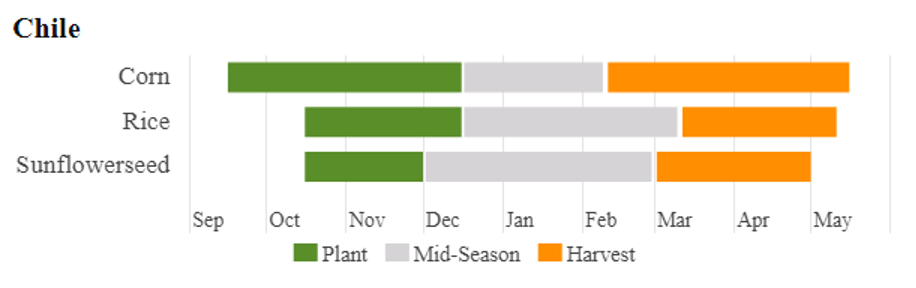
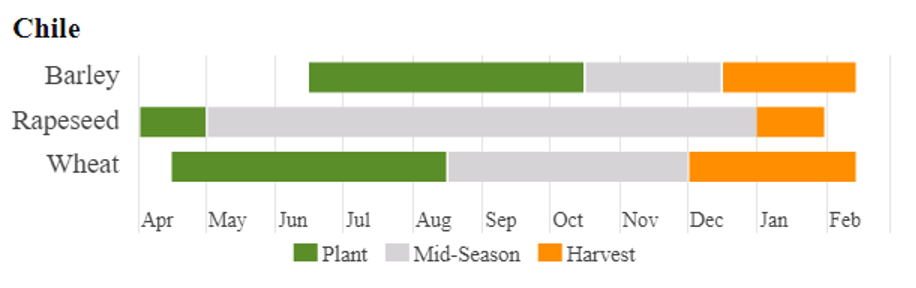
Chile has distinct summer and winter agricultural seasons, with its long, narrow geography allowing for a wide variety of crops. The summer growing season generally runs from September to May, while the winter season is from approximately April to February.
Table 3: Chilean agricultural cropping periods
|
Cropping period |
Start |
End |
|---|---|---|
|
Cropping year |
May 1 |
April 30 |
|
Winter |
April 1 |
February 28 |
|
Summer |
September 1 |
May 15 |
Crop Calendar
The Foreign Agricultural Service of the USDA provides crop calendars for major cropping seasons globally. Here we provide graphics showing the major cropping seasons in Chile.
Primary crops
Chilean crops for which statistics are found in the FEWS NET Data Warehouse are listed in the table below.
Note: English and Scientific name equivalents are only indicative.
Table 4: Chilean crops and approximate meanings
|
Crop |
Source Crop |
English name |
Scientific name |
|---|---|---|---|
|
R01219AK |
Achicoria industrial |
Endive |
Cichorium endivia L. |
|
R01132AA |
Arroz |
Rice (paddy) |
Oryza sativa |
|
R01705AA |
Arveja |
Garden pea |
Pisum sativum |
|
R01172AA |
Avena |
Oats |
Avena sativa |
|
R01152AA |
Cebada |
Barley |
Hordeum vulgare |
|
R01659AC |
Cebada cervecera |
Barley for beer |
Hordeum vulgare |
|
R01919AE |
Cebada forrajera |
Barley fodder |
Hordeum vulgare |
|
R01162AA |
Centeno |
Rye |
Secale cereale |
|
R01659AC |
Centeno forrajera |
Rye fodder |
Secale cereale |
|
R01709AG |
Chícharo |
Chickling pea |
Lathyrus sativus |
|
R01703AA |
Garbanzo |
Chick pea |
Cicer arietinam |
|
R01704AA |
Lenteja |
Lentil |
Lens culinaris |
|
R01709AH |
Lupino |
Lupine |
Lathyrus tuberosus |
|
R01709BC |
Lupino Amargo |
Bitter lupine |
Lupinus mutabilis |
|
R01709BB |
Lupino Australiana |
Australian lupine |
Lupinus angustifolius |
|
R01709AV |
Lupino Dulce |
Sweet lupine |
Lupinus albus |
|
R01122AA |
Maíz |
Maize |
Zea maize |
|
R01121AA |
Maíz Semilla |
Maize seed |
Zea maize |
|
R01445AA |
Maravilla |
Sunflower seed |
Helianthus annuus |
|
R01709XX |
Otras leguminosas |
Other legumes |
|
|
R01190XX |
Otros cereales |
Other cereals |
|
|
R01510AA |
Papa |
Potato |
Solanum tuberosum |
|
R01701AG |
Poroto |
Large white bean |
Phaseolus vulgaris |
|
R01443AA |
Raps |
Rapeseed |
Brassica napus |
|
R01801AA |
Remolacha |
Beet |
Beta vulgaris |
|
R01801AA |
Remolacha azucarera |
Sugarbeet |
Beta vulgaris |
|
R01970AA |
Tabaco |
Tobacco |
Nicotiana tabacum |
|
R01234AA |
Tomate industrial |
Tomato, industrial |
Solanum lycopersicum |
|
R01112AA |
Trigo |
Wheat |
Triticum aestivum |
|
R01112AI |
Trigo Candeal |
Durum wheat |
Triticum durum |
|
R01112AG |
Trigo Harinero |
Soft wheat |
Triticum aestivum |
|
R01190AF |
Triticale |
Triticale |
Triticosecale |
Production systems
In some regional agricultural crop statistics, crops are distinguished by being rainfed or irrigated. In complete national coverage at the Province-level, no distinctions are made.
Crop statistics context
Chilean crop statistics available in the FEWS NET Data Warehouse cover the period between 1980 and the present.
Area is denominated in hectares, and weights are given in kilograms and quintals (1/10 metric ton).
Methodology
Complete details about methods used in the two annual surveys of crops (one for area estimates, and one at the end of the season for quantity produced) are available on the INE website in the Metodologías sub-menu.