
Last update: December 2025
This page contains information about some of the data available in the FEWS NET Data Explorer (FDE) for Turkey (Türkiye). This is not a comprehensive guide.
For information about using the filters and fields for specific topics in the FDE, see Explore Data.
Summary table
|
ISO 3166-1 codes |
Alpha 2: TR, Alpha 3: TUR, Numeric: 792 |
|---|---|
|
Administrative units |
Province, district |
|
Agricultural seasons |
Main, winter |
|
Major crops |
Wheat, barley, maize, sunflower, sugarbeets |
Acknowledgements
The Turkey/Türkiye crop dataset found in the FEWS NET Data Warehouse, and this Country Data Book publication are a joint effort of the United States Department of State-funded Famine Early Warning Systems Network (FEWS NET) and the Joint Research Centre (JRC) of the European Commission-managed HarvestStat Middle East/North Africa (MENA). HarvestStat MENA provides datasets of subnational crop data for 10 countries across the Middle East and North Africa in formats that are interoperable with the FEWS Data Warehouse and ready for academic analysis. For additional information, please refer to the HarvestStat vision paper, the HarvestStat website, and the FEWS Data Explorer Knowledge Base.
Country food security context
Statistical reporting units
Turkey officially changed its name to Türkiye at the United Nations in June 2022. The change is less of a name change and more of an official adoption of the name that has been used internally since the republic's founding in 1923, in an effort to align its international English name with its Turkish one.
Turkey (Türkiye) usually uses administrative units as their statistical reporting units.
Administrative (admin) units are the geographical areas into which a country is divided. FEWS NET uses the following terminology: National boundary = admin 0, First sub-national division = admin 1 (e.g., states in the United States), Second sub-national division = admin 2 (e.g., counties in the United States), and so on.
There are three principal levels of administrative divisions in Türkiye.
Admin 1: Province (il), of which there are currently 81.
Admin 2: District (ilçe), currently 973 in number.
Admin 3: Local government entities, of which there are municipalities (belediye), villages (köy) and greater municipalities (büyükşehir belediyesi) inside of large urban municipalities.
Geographic regions: There are also twelve geographical regions of Türkiye (bölge) which were originally defined at the country's First Geography Congress in 1941. Regions, as defined in this context, are merely for geographic, demographic, and economic purposes and do not refer to an administrative division.
FEWS NET’s use of Wikipedia
While Wikipedia may not be appropriate for all research contexts, it serves as a valuable and often irreplaceable source for certain types of information. For rapidly changing administrative data where timeliness is critical, Wikipedia's strengths often outweigh the limitations typically associated with user-generated content, as is the case here.
Crop data
Explore our crop data.
Crop estimate data sources
Turkish crop statistics are found in an online database managed by the Turkish Statistical Institute (TurkStat)/Türkiye İstatistik Kurumu'nun (TÜİK) and disseminated through the Central Dissemination System/MEDAS (English-language version).
To download crop statistics from the Central Dissemination System, use the following:
-
Subject: Crop Production Statistics
-
Measurement: Choose what is relevant, such as Cereals and other crop products or Vegetables
-
Dimensions: Choose optional dimensions if desired then click Ok.
-
Product characteristics: Includes options like Sown area and Production quantity. Choose at least one.
-
Crop: Choose at least one.
-
Measurement Unit: Includes options like Decare and Tonne. Choose at least one.
-
-
Click Add measurements. Review selections and click Forward.
-
Time: Choose a relevant time frame. Click Forward.
-
Region: Choose a region type, then select relevant regions. Click Create Report.
-
You can view the table on the screen or download the report as a .csv or .xls file.
Crop reporting units
A user of official Turkish crop statistics (2004 to present) has a choice of several spatial sub-divisions of the national crop statistics database (see below, and the Central Dissemination System/MEDAS English-language version).
FEWS NET Data Warehouse crop data for Türkiye draws from this website’s (and a precursor site) Province-level database, which comprises the 81 provinces of the country as the framework for the sub-national crop statistics.
There are four other crop statistics databases available here, all using the Eurostat NUTS (Nomenclature of Territorial Units for Statistics) statistical standard, a hierarchical system of statistical regions used by the European Union for collecting data, conducting socio-economic analyses, and framing regional policies like cohesion policy. This system is based on population thresholds and divides territories into three main levels: NUTS 1 (major regions), NUTS 2 (basic regions for policy), and NUTS 3 (small regions for specific analysis).
For Türkiye, NUTS 1 sub-divides the country into the 12 geographic units briefly described above. NUTS 2-level units comprise 26 territorial units, most of them grouping more than one province. NUTS 3-level crop statistics are equivalent to the Province-level described above. NUTS 4-level local data are divided into 974 districts that together comprise the 81 provinces. NUTS 4-level data can only be downloaded province-by-province, by NUTS 3-level units.
Evolution of Administrative and Crop Statistic Reporting Units
Between the date of the official establishment of the Republic of Türkiye on 29 October 1923, and 1957, provinces were added to the administrative system, resulting in the 67 province line-up shown below, with corresponding province automobile license plate codes.
Provinces added each year are as follows:
-
1989: Aksaray (TR68), Bayburt (TR69), Karaman (TR70), and Kırıkkale (TR71)
-
1990: Batman (TR72) and Şırnak (TR73)
-
1991: Bartın (TR74)
-
1992: Ardahan (TR75) and Iğdır (TR76)
-
1995: Yalova (TR77), Karabük (TR78), and Kilis (TR79)
-
1996: Osmaniye (TR80)
-
1999: Düzce (TR81)
No changes have occurred since.
Table 1: Provinces
|
TR Code |
Province |
|---|---|
|
TR01 |
Adana |
|
TR02 |
Adıyaman |
|
TR03 |
Afyonkarahisar |
|
TR04 |
Ağrı |
|
TR05 |
Amasya |
|
TR06 |
Ankara |
|
TR07 |
Antalya |
|
TR08 |
Artvin |
|
TR09 |
Aydın |
|
TR10 |
Balıkesir |
|
TR11 |
Bilecik |
|
TR12 |
Bingöl |
|
TR13 |
Bitlis |
|
TR14 |
Bolu |
|
TR15 |
Burdur |
|
TR16 |
Bursa |
|
TR17 |
Çanakkale |
|
TR18 |
Çankırı |
|
TR19 |
Çorum |
|
TR20 |
Denizli |
|
TR21 |
Diyarbakır |
|
TR22 |
Edirne |
|
TR23 |
Elazığ |
|
TR24 |
Erzincan |
|
TR25 |
Erzurum |
|
TR26 |
Eskişehir |
|
TR27 |
Gaziantep |
|
TR28 |
Giresun |
|
TR29 |
Gümüşhane |
|
TR30 |
Hakkâri |
|
TR31 |
Hatay |
|
TR32 |
Isparta |
|
TR33 |
Mersin |
|
TR34 |
Istanbul |
|
TR35 |
İzmir |
|
TR36 |
Kars |
|
TR37 |
Kastamonu |
|
TR38 |
Kayseri |
|
TR39 |
Kırklareli |
|
TR40 |
Kırşehir |
|
TR41 |
Kocaeli |
|
TR42 |
Konya |
|
TR43 |
Kütahya |
|
TR44 |
Malatya |
|
TR45 |
Manisa |
|
TR46 |
Kahramanmaraş |
|
TR47 |
Mardin |
|
TR48 |
Muğla |
|
TR49 |
Muş |
|
TR50 |
Nevşehir |
|
TR51 |
Niğde |
|
TR52 |
Ordu |
|
TR53 |
Rize |
|
TR54 |
Sakarya |
|
TR55 |
Samsun |
|
TR56 |
Siirt |
|
TR57 |
Sinop |
|
TR58 |
Sivas |
|
TR59 |
Tekirdağ |
|
TR60 |
Tokat |
|
TR61 |
Trabzon |
|
TR62 |
Tunceli |
|
TR63 |
Şanlıurfa |
|
TR64 |
Uşak |
|
TR65 |
Van |
|
TR66 |
Yozgat |
|
TR67 |
Zonguldak |
Year and season definition
Year definition
The agricultural cropping/reporting year in Türkiye runs between October 1 and September 30 of the next year.
Example: 2024 refers to October 1, 2023 - September 30, 2024
Seasons
In general, Türkiye experiences four agricultural seasons during its agricultural cropping year:
-
Autumn: September - November
-
Winter: December - February
-
Spring: March - May
-
Summer: June - August
At the regional and local levels, there is significant climate variation due to Türkiye’s continental and maritime exposures and its varied topography.
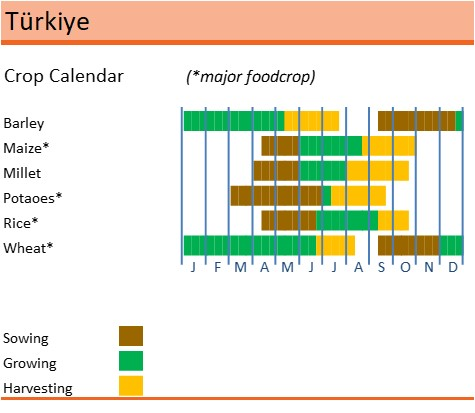
Spring is the season of planting for many crops. Summer is generally characterized by crop growth and development, and Autumn is the harvest season, when most crops are gathered. Wheat and barley are the major winter season crops, being planted as early as September in one year, and harvested as late as August in the next.
A notable exception to one main season crop is found in the Mediterranean Region of Türkiye. There, maize can be cultivated twice a year between March and October. The first maize growing season starts from March to June, followed by the second cropping season from June/July to October.
Table 2: Seasonal definitions
|
|
Start |
End |
|---|---|---|
|
Cropping year |
1-Oct |
30-Sep |
|
Main season |
1-Mar |
30-Sep |
|
Winter season |
15-Sep |
15-Aug |
Crop Calendar
Primary crops
Table 3: Turkish crops in the FEWS Data Warehouse
|
Crop code |
Source crop name |
DNL source crop (Eng) |
Scientific name |
|---|---|---|---|
|
R01620AI |
Adaçayı |
Sage |
Salvia oficinalis |
|
R01709AL |
Adi fiğ |
common vetch |
Vicia sativa |
|
R01659AC |
Arpa Biralık |
barley, brewing |
Barley for brewing |
|
R01152AA |
Arpa Diğer |
barley |
Hordeum vulgare |
|
R01446AA |
Aspir Tohumu |
safflower seed/canola |
Carthamus tinctorius |
|
R01445AA |
Ayçiçeği tohumu Çerezlik |
sunflower seed |
Helianthus annuus |
|
R01445AB |
Ayçiçeği tohumu Yağlık |
sunflower seed (oil) |
Helianthus annuus |
|
R01702AA |
Bakla, kuru (İnsan Tüketimi İçin) |
broad bean, dry |
Vicia faba |
|
R01241AC |
Bakla, taze |
broad bean, fresh |
Vicia faba |
|
R01701AK |
Barbunya, kuru |
kidney bean |
Phaseolus vulgaris |
|
R01241AD |
Barbunya, taze |
kidney bean, fresh |
Phaseolus vulgaris |
|
R01919CA |
Bezelye yesil ot |
pea fodder |
Pisum sativum |
|
R01705AA |
Bezelye, kuru |
pea, dry |
Pisum sativum |
|
R01242AA |
Bezelye, taze |
pea, fresh |
Pisum sativum |
|
R01706AA |
Börülce kuru |
cowpea, dry |
Vigna unguiculata |
|
R01242AD |
Borulce, taze |
cowpea, fresh |
Vigna unguiculata |
|
R01919BA |
Buğday Hasıl yesilot |
wheat fodder |
Triticum aestivum |
|
R01112AA |
Buğday, Durum Buğdayı Hariç |
wheat, except durum |
Triticum aestivum |
|
R01709AG |
Burçak Dane |
chickling vetch |
Lathyrus sativus |
|
R01702AD |
Buy Çemen Otu |
fenugreek |
Trigonella foenum-graecum |
|
R01162AA |
Çavdar |
rye |
Secale cereale |
|
R01132AA |
Celtik |
rice |
Oryza sativa |
|
R01182AA |
Darı |
millet |
Millet spp. |
|
R01709AK |
Dilice ot |
cow vetch |
Vicia cracca |
|
R01112AB |
Durum Buğdayı |
wheat, durum |
Triticum durum |
|
R01701AA |
Fasulye, kuru |
bean, dry |
Phaseolus vulgaris |
|
R01241AA |
Fasulye, taze |
bean, fresh |
Phaseolus vulgaris |
|
R01919AI |
Fiğ Adi Yesil Ot |
vetch, ordinary, fodder |
Lathyrus sativus |
|
R01919CQ |
Fiğ Macar Yesil Ot |
vetch, hungarian, fodder |
Vicia pannonica |
|
R01422AA |
Fıstığı, Kabuklu |
groundnut in shell |
Arachis hypogaea |
|
R01930AP |
Haşhaş tohumu |
poppy seed |
Papaver somniferum |
|
R01919AH |
Hayvan Seker Pancarii |
beet fodder |
Beta vulgaris |
|
R01443AA |
Kanola Veya Kolza Tohumu |
canolaseed |
Brassica rapa dichotoma |
|
R01112AJ |
Kaplıca |
einkorn wheat |
Triticum monococcum |
|
R01190AE |
Kara Buğday |
wheat, black |
Fagopyrum esculentum |
|
R01441AA |
Keten tohumu |
flaxseed |
Linum usitatissimum |
|
R01919BQ |
Korunga (Yesilot) |
fodder, sainfoin |
Onobrychis viciifolia |
|
R01212AH |
Lahana Beyaz |
cabbage, white |
Brassica oleracea capitata |
|
R01213AL |
Lahana Kara Yaprak |
cabbage, black leaf |
Brassica oleracea |
|
R01212AB |
Lahana Kirmizi |
cabbage, red |
Brassica oleracea capitata |
|
R01654AK |
Lavanta |
Lavendar |
Lavandula angustifolia |
|
R01112AL |
Mahlut |
meslin |
Triticum x secale |
|
R01704AB |
Mercimek, kuru Kirmizi |
lentil, dry red |
Lens culinaris |
|
R01704AA |
Mercimek, kuru Yesil |
lentil, dry green |
Lens culinaris |
|
R01122AA |
Misir |
maize |
Zea mays |
|
R01911AA |
Misir slaj |
maize silage |
Zea mays |
|
R01709AH |
Mürdümük |
tuberous vetchling |
Lathyrus tuberosus |
|
R01919CR |
Mürdümük (Yesilot) |
tuberous vetchling fodder |
Lathyrus tuberosus |
|
R01703AA |
Nohut, kuru |
chickpea, dry |
Cicer arietinum |
|
R01432AA |
Pamuk Çekirdeği Çiğit |
cottonseed |
Gossypium |
|
R01921AA |
Pamuk, Çırçırlanmış Lifli |
cotton fiber |
Gossypium |
|
R01510AA |
Patates (Tatli Patates Haric) |
Potato |
Solanum tuberosum |
|
R01132AA |
Pirin |
rice |
Oryza sativa |
|
R01259AH |
Salep |
orchid tuber |
Orchis |
|
R01801AA |
Şeker Pancari |
sugar beet |
Beta vulgaris |
|
R01142AA |
Sorgum |
sorghum |
Sorghum bicolor |
|
R01919AV |
Sorgum (Yesilot) |
Sorghum fodder |
Sorghum bicolor |
|
R01412AA |
Soya Fasulyesi |
soybean |
Glycine max |
|
R01444AA |
Susam Tohumu |
sesame seed |
Sesamum indicum |
|
R01591AA |
Tatlı Patates |
Sweet potato |
Ipomoea batata |
|
R01190AF |
Tritikale |
triticale |
Triticosecale |
|
R01919AZ |
Tritikale (Yesilot) |
triticale fodder |
Triticosecale |
|
R01970AA |
Tütün |
tobacco |
Nicotiana tabacum |
|
R01970AA |
Tütün, Islenmemis |
tobacco |
Nicotiana tabacum |
|
R01919AO |
Yem Şalgamı |
turnip fodder |
Brassica napo |
|
R01599AN |
Yer Elması |
Jerusalem artichoke |
Helianthus tuberosus |
|
R01422AA |
Yer fıstığı |
groundnut in shell |
Arachis hypogaea |
|
R01912AA |
Yonca (Yesilot) |
fodder, alfalfa |
Medicago sativa |
|
R01172AA |
Yulaf |
oats |
Avena sativa |
|
R01919AQ |
Yulaf (Yesilot) |
oat fodder |
Avena sativa |
Production systems
Turkish crop statistics carry no additional crop production system (e.g. rainfed, irrigated, etc.) information.
Crop statistics context
Turkish crop statistics available from the source described above cover a period between 2004 and the present. A source for earlier crop statistics has not been identified.
Area sown and area harvested data is given in decare units, which is 1/10th of a hectare. Production quantity is given in tonnes.
Quarterly data on agricultural production and on cultivated land are compiled by the Turkish Ministry of Agriculture and Forestry in a Quarterly Production of Field Crops, Quarterly Production of Fruits and Quarterly Production of Vegetables. The data generated in these reports is then used by the Turkish Statistical Institute (TURKSTAT) to compile yearly reports and two annual estimations (first in May, second in October) that offer a comprehensive overview of the agricultural year.
Summary national crop statistics for the most recent 3 years may be found on the Ministry of Agriculture and Forestry website.
Methodology
TurkStat is responsible for data processing, evaluation, publication and dissemination of agricultural statistics. But pursuant to Decree Law No. 639 on the Organisation and Tasks of the Ministry of Food, Agriculture and Livestock (MoFAL), annual data collection for crop production and animal production statistics and monthly agricultural price statistics are performed by the Province and District.
MoFAL and TurkStat have a long tradition of cooperation for the production of agricultural statistics. There are 2,200,000 agricultural holdings according to the Farmers Registry System (FRS). Within MoFAL, the Geographical Information Systems Department under the General Directorate of Agricultural Reform (GDAR) is assigned with the task of collecting agricultural data. For this purpose, the Statistical Data Network (SDN), a web-based data system for data collection, has been established by MoFAL and the 81 Province and 903 District Directorates enter data into this system. SDN data is jointly analysed by MoFAL and TurkStat, and published by TurkStat.