
Last update: January 2026
This page contains information about some of the data available in the FEWS NET Data Explorer (FDE) for Bolivia. This is not a comprehensive guide.
For information about using the filters and fields for specific topics in the FDE, see Explore Data.
Summary table
|
ISO 3166-1 codes |
Alpha 2: BO, Alpha 3: BOL, Numeric: 068 |
|---|---|
|
Administrative units |
Department, province, municipality, canton |
|
Agricultural seasons |
Summer/verano, winter/invierno |
|
Major crops |
Maize, sorghum, beans, rice, soybeans, tubers |
Acknowledgements
The Bolivia crop dataset found in the FEWS NET Data Warehouse, and this Country Book publication are a joint effort of the United States Department of State-funded Famine Early Warning Systems Network (FEWS NET) and the Stockholm Environmental Institute via HarvestStat Latin America and Caribbean (LAC). HarvestStat LAC provides a dataset of subnational crop data for 27 countries across Central and South America and the Caribbean in formats that are interoperable with the data in the FEWS Data Warehouse and ready for academic analysis. For additional information, please refer to the HarvestStat vision paper, the HarvestStat website, and the FEWS Data Explorer Knowledge Base.
Country food security context
Statistical reporting units
Bolivia usually uses administrative units as their statistical reporting units.
Administrative (admin) units are the geographical areas into which a country is divided. FEWS NET uses the following terminology: National boundary = admin 0, First sub-national division = admin 1 (e.g., states in the United States), Second sub-national division = admin 2 (e.g., counties in the United States), and so on.
Admin 1: Departamentos/Departments (9 total) have not changed in number or shape since 1943:
-
Beni
-
Chuquisaca
-
Cochabamba
-
La Paz
-
Oruro
-
Pando
-
Potosi
-
Santa Cruz
-
Tarija
Admin 2: Provincias/Provinces (112 total) have remained without change in their boundaries since the 1950s.
Admin 3: Municipios/Municipalities (340 total)
Admin 4: Cantones/Cantons (>1,370)
Evolution of Administrative and Crop Statistic Reporting Units
As noted above, there have been no changes in Admin 1 departament-level crop reporting units since the 1940s, when a short-lived Chaco department was created and then folded into Tarifa Department. At the municipio-level, their number increased from 24 in 1994, to approximately 340 today, following passage of the 1994 Law of Popular Participation.
Crop data
Explore our crop data.
Bolivia’s crop statistics at the Departamento-level (admin 1) cover the period from 1983 to the present. Seasonal break-outs (winter/invierno and summer/verano) of the Departamento statistics are available only from 2013 to the present. Departamento-level crop statistics represent 13.4% of the total crop statistics database for Bolivia.
Bolivia’s Municipio-level (admin 3) crop statistics cover the period between 2013 and the present. There are no seasonal break-outs, only annual totals, for Municipio-level crop statistics. In terms of volume, the Municipio-level crop statistics account for 86.6% of the total number of crop statistics for the country.
According to standard practices with FDW crop statistics, the longer data series, the Departamento-level Admin 1 data, is generally chosen as the primary dataset for Bolivia, and the Municipio-level Admin 3 data, despite constituting a much larger share of the total dataset, will be considered an alternate crop dataset. Access to this data via the FEWS NET Data Platform is available upon request.
Crop estimate data sources
There are at least three principal sources for Bolivian crop statistics:
The OAP website offers municipio-level crop statistics under the menu choice Reporte Agrícola Municipal.
The Bolivia Vice-Ministry of Agriculture Development and Integrated Development, (Vice-Ministerio de Desarollo Agro-pecuario y Desarollo integral – VDADI) does not provide crop statistics.
Crop reporting units
The country reports its crop statistics at the Admin 1 (departamento) and Admin 3 (municipio) levels. Admin 3-level municipio crop statistics are available as of 2013.
Year and season definition
Agricultural year
Bolivia's traditional Año Agrícola (Agricultural Year) begins around the Winter Solstice, specifically June 21st at Tiwanaku, marking the Aymara New Year (Machaj Mara) and honoring Pachamama (Mother Earth) for a new cycle of planting and harvesting.
Nevertheless, Bolivia's annual agricultural production is calculated and reported by adding the Summer crops to the Winter crops which follow it, both harvests occurring in the same Gregorian calendar year, for an end-aligned November to October crop year (with differences between regions).
Example: Harvests occurring between November 2022 through October 2023 would be the country's 2023 harvest.
Season definitions
The timing of Bolivia's summer and winter agricultural seasons changes significantly depending upon altitude. But generally, the Summer season is described as beginning in November and finishing in April or May, and the winter season begins in May, finishing by the end of October.
Table 1: Bolivian agricultural cropping periods
|
Cropping period |
Start |
End |
|
Cropping year |
November 1 (year - 1) |
October 31 (year) |
|
Summer |
November 1 (year - 1) |
April 30 (year) |
|
Winter |
May 1 (year) |
October 31 (year) |
Crop Calendar
The Foreign Agricultural Service of the USDA provides crop calendars for major cropping seasons globally. Here we provide graphics showing the major cropping seasons in Bolivia.
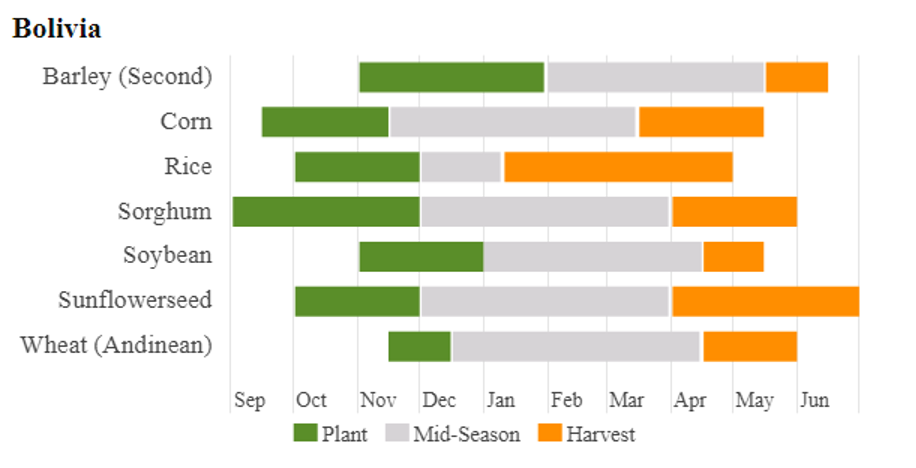
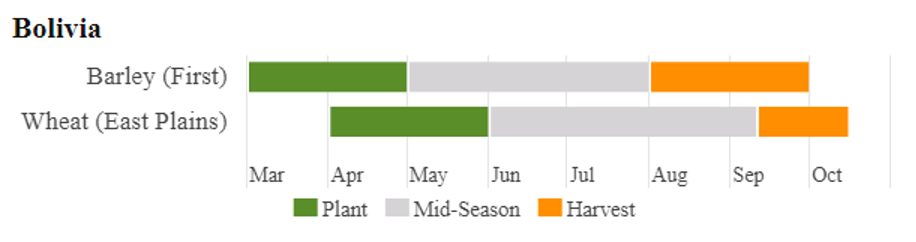
Primary crops
Bolivian crops for which statistics are found in the FEWS NET Data Warehouse are listed in the table below.
Table 2: Bolivian crops and approximate meanings
|
Crop name (Sp) |
Crop name (En) |
Crop code |
|---|---|---|
|
Achiote (urucú) |
Annatto |
R01690AD |
|
Ají |
Hot pepper |
R01652AA |
|
Ajo |
Garlic |
R01252AB |
|
Alfalfa |
Alfalfa |
R01912AA |
|
Algodón |
Cotton |
R01921AA |
|
Arroz con cáscara |
Rice (paddy) |
R01132AA |
|
Arveja |
Garden pea |
R01242AA |
|
Avena |
Oats |
R01172AA |
|
Avena berza |
Oats for alcohol |
R01659AD |
|
Banano |
Banana |
R01312AA |
|
Betarraga |
Beet (table) |
R01259AA |
|
Cacao |
Cocoa |
R01640AA |
|
Café |
Coffee |
R01610AA |
|
Camote |
Sweet potato |
R01591AA |
|
Caña de Azúcar |
Sugarcane |
R01802AA |
|
Cañahua |
Canihua |
R01190AJ |
|
Cebada berza |
Barley fodder |
R01659AC |
|
Cebada en grano |
Barley |
R01152AA |
|
Cebolla |
Onion, bulb |
R01253AA |
|
Centeno |
Rye |
R01162AA |
|
Chía |
Chia seed |
R01190AK |
|
Coliflor |
Cauliflower |
R01213AA |
|
Frijol/poroto |
Bean, common |
R01701AD |
|
Garbanzo |
Chickpea |
R01703AA |
|
Girasol |
Sunflower seed |
R01445AA |
|
Haba |
Broad bean |
R01702AC |
|
Haba verde |
Broad bean (fresh) |
R01702AC |
|
Hualuza |
Tannia |
R01595AE |
|
Lechuga |
Lettuce |
R01214AA |
|
Lima |
Lima bean |
R01322AB |
|
Locoto |
Hot pepper (Capsicum pubescens) |
R01652AG |
|
Maíz choclo |
Maize (green/fresh) |
R01122AE |
|
Maíz en grano |
Maize grain |
R01122AA |
|
Maní |
Groundnut |
R01422AA |
|
Oca |
Oca root |
R01599AG |
|
Palta |
Avocado |
R01311AB |
|
Papa |
Potato |
R01510AA |
|
Papaliza |
Olluco tuber |
R01599AH |
|
Pepino |
Cucumber |
R01232AA |
|
Piña |
Pineapple |
R01318AA |
|
Plátano |
Plantain |
R01313AA |
|
Quínua |
Quinoa grain |
R01190AD |
|
Rábano |
Radish |
R01259AC |
|
Racacha |
White carrot root |
R01599AI |
|
Repollo |
Cabbage |
R01212AA |
|
Sandía |
Watermelon |
R01221AA |
|
Sésamo |
Sesame seed |
R01444AA |
|
Sorgo en grano |
Sorghum grain |
R01142AA |
|
Soya |
Soybean |
R01412AA |
|
Tabaco |
Tobacco |
R01970AA |
|
Té |
Tea |
R01620AA |
|
Tomate |
Tomato |
R01234AA |
|
Trigo |
Wheat grain |
R01112AA |
|
Tuna |
Prickly pear fruit |
R01319AT |
|
Vainitas |
Green bean (fresh) |
R01241AA |
|
Yuca |
Cassava |
R01592AA |
|
Zanahoria |
Carrot |
R01251AA |
|
Zapallo |
Zucchini |
R01235AB |
Production systems
In some regional agricultural crop statistics, crops are distinguished by being rainfed or irrigated. In complete national coverage at the Province-level, no distinctions are made.
Crop statistics context
Area is denominated in hectares, and weights are given in kilograms and tons (metric).
Methodology
Complete details about methods used in the annual surveys of crops are available on the INE website in the Ficha Técnica and Metadatos sub-menus.