If unfamiliar with the concepts of Survival and Livelihood Protection Thresholds, learn more. This section explains the calculations used in the Survival and Livelihood Protection baskets graph.
The Survival and Livelihood Protection Thresholds are determined using categories of products called baskets. Each Product associated with a Livelihood Activity in a BSS is assigned to one of the following baskets for each Wealth Group:
-
Survival main staple crop (e.g., Maize/corn grain or Sorghum grain, etc.)
-
Survival other staple food purchases (e.g., Cooking Oil, Flour, Salt)
-
Survival non-food purchases (e.g., Soap, Cooking Fuel, Lighting, Tea)
-
Livelihood protection purchases (e.g., Seeds, Fertilizer, Animal Drugs)
The total allocation of a Livelihood Activity to each basket may not be 100%. For example, OtherPurchase of kerosene may be allocated as 75% in the survival non-food purchases basket. Because LEX only stores one category per product, the remaining 25% would implicitly be part of an “other” basket of discretionary spending, not associated with either the Survival or Livelihood Protection Thresholds.
For the survival expenditures, the Livelihoods Explorer applies the principle that all humans have the same minimum survival needs, including for water for human consumption. These minimum needs are determined based on those of the Poor wealth group (i.e., the Poor’s expenditure and allocation is assigned to all household groups for the Survival Threshold).
The allocation of livelihood protection purchases, however, can vary by Wealth Group. For example, cooking needs may require 75% of the total for Very poor and Poor households, but only 50% for Middle and Better off households.
The definition and calculation for each Threshold is described in the following chart.
|
Threshold |
Includes |
Calculation |
|---|---|---|
|
Survival |
|
Sum of the following baskets for the Poor Wealth Group:
This threshold is the same across all Wealth Groups in a Livelihood Zone. |
|
Livelihood Protection |
|
This threshold is calculated per Wealth Group by adding the livelihood protection purchases basket to the Survival Threshold. Every Wealth Group gets its own allocation for the livelihood protection purchases basket. For any Livelihood Strategy that a Wealth Group doesn't have its own allocation for, it will inherit the allocation from the Poor Wealth Group. |
Within the Livelihoods Explorer Database, the percentage of kcals allocated to a basket for a product category are calculated as follows:
-
Main staple -
100% of minimum food energy needs-The percentage of food energy needs provided by the other staple food basket. That is, this basket simply includes the remainder of the minimum kcals required for survival after basket 2 (other staple food) is subtracted. Note that the amount of the main staple included in this basket is not derived from either Crop Production or Food Purchase of that crop. Instead, the Thresholds assume that households will purchase the amount of the main staple needed to reach 100% of their required kcals per person per day (pppd) after consuming the kcals from the other survival food basket.
-
Other staple food -
percentage_kcals×percentage_allocation_to_basket. This includes all food purchases other than the main staple.percentage_kcalsrepresents the percentage of total kcals, not the percentage of 2100 kcals pppd. -
Survival non-food -
expenditure×percentage_allocation_to_basket, converted to kcals using theannual_kcals_cost. -
Livelihood protection -
expenditure×percentage_allocation_to_basket, converted to kcals. If any activities in this basket are recorded as kcals instead of, or in addition to, cash (expenditure), the kcals portion of the activity is omitted from the livelihood protection basket. This is because all kcals assumed to be available for survival have already been included in baskets 1 and 2 such that the kcals should not be necessary for livelihood protection.
Example
In NG21, and in all Baselines, the Survival Threshold is made up of the same three components for all Wealth Groups.
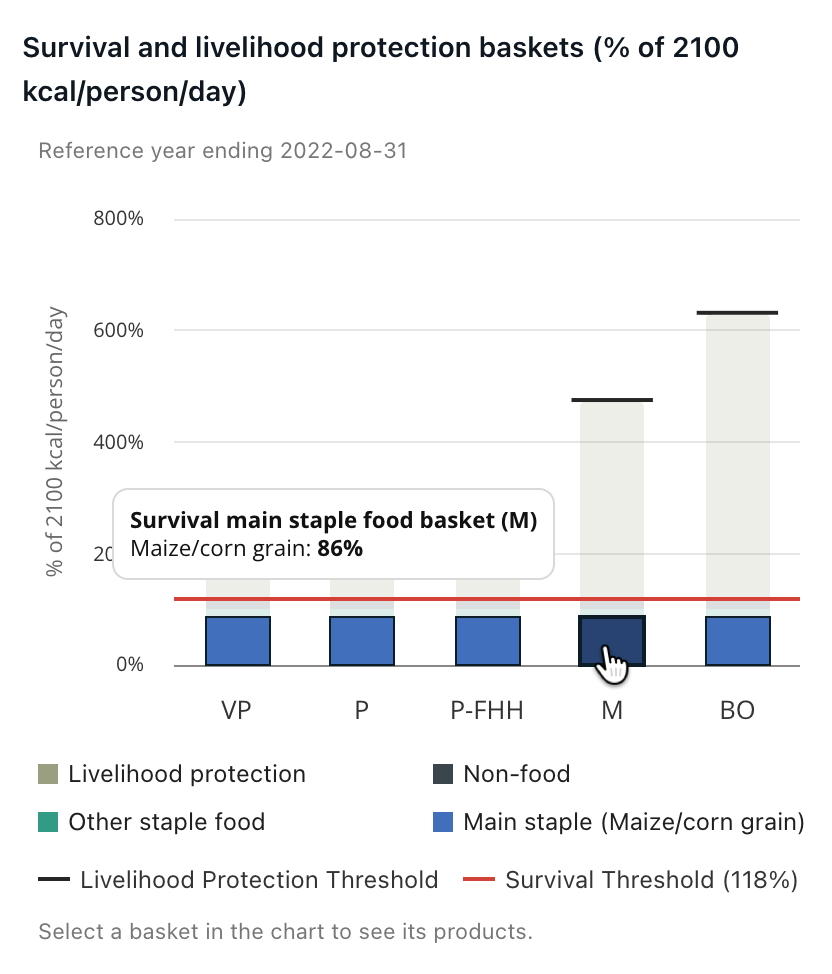
Main staple, maize, accounts for 86% of the necessary 2100 kcals pppd.
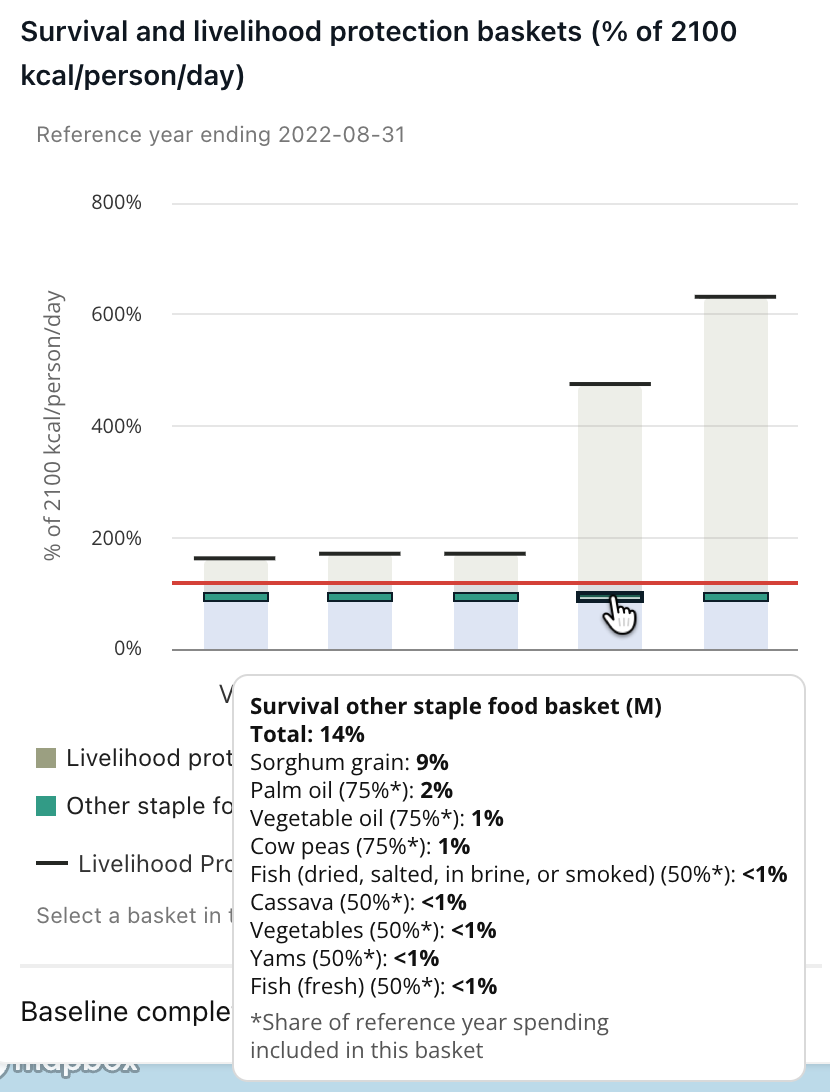
Other staple food basket makes up 14% of the necessary 2100 kcals pppd. This includes 9% that comes from sorghum.
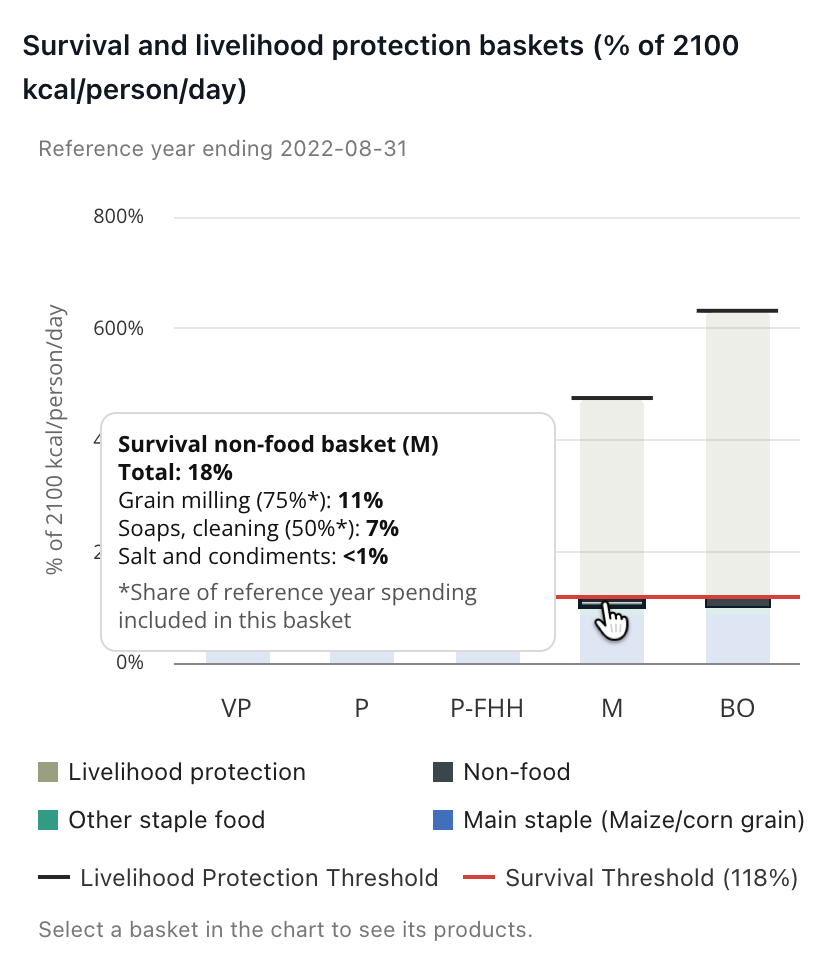
Survival non-food basket, worth 18% of 2100 kcals, primarily from grain milling and soap.
In looking at the Survival non-food basket, you can see that 75% of the grain milling activity is allocated to the basket, accounting for 11% of the 18% that basket costs. You can check this math by looking at the expenditures. The Poor Wealth Group expend 51,800 NGN per year on grain milling.
expenditure × percentage_allocation_to_basket = 51,800 NGN × 75% = 38,850 NGN
To convert this to a percentage of 2100 kcals pppd, use the annual kcals cost (369,910 NGN) for the Poor Wealth Group, which can be found in the Compare view. 38,850 NGN ÷ 369,910 NGN = 10.5%, which is rounded up to 11%.