The following recommendations for data entry pertain to the WB and Data sheets in a BSS.
Adding and removing rows and columns
One of the benefits of using a database for data collection and analysis is that you do not have to worry about adding rows and columns to your spreadsheet as they can not break anything.
Therefore, we recommend adding rows and columns where needed in order to keep data tidy in the spreadsheet. For example, if a section only has space for 3 items but you have 5 items to record, you do not need to make the data fit into 3 sets of rows. In fact, forcing the data to fit will make ingestion harder. Instead, add two additional sets of rows to accommodate all of your data.
This also means that you can have rows for both individual and summary data.
Example
Each village in a BSS produces a different vegetable: squash, tomatoes, chilies, etc. Traditionally, they might all fall under one set of rows with the label mixed vegetable production. However, now the best approach is to list each product in a different set of rows. If a summary of mixed vegetable production is still desired, it can be included in its own set of rows containing only the summary data and no community-level data.
Duplicate rows should be removed to prevent duplicate entries in the database.
Example
In this example, rows 632-3 are repeated in rows 634-5. An entry for labor migration will be created for rows 632 and 633. A second entry for labor migration will be created for the information in rows 636 - 638. Ideally, rows 634-5 are deleted.

IDPs
While it is rare for one BSS to contain data for both IDPs and the local community, it does happen on occasion. In this instance, use a single WB sheet, add rows/columns as needed and rename the wealth categories in column B. Likewise, use a single data sheet, add rows/columns as needed, and rename the wealth categories at the top, usually in row 3. The labels should make it clear which wealth groups are IDPs. For example, a French BSS would use TP for the very poor in the community and TP-IDP for the very poor in the displaced population.
Column A
The labels in column A are used to tell the data ingestion pipeline what kind of information is stored in that row of the spreadsheet. Therefore, it is important to understand the patterns that the pipeline is looking for.
Rowsets
In general, the start of a new rowset (i.e. a full set of rows with data about a single product) should have a label in column A structured as Product: Attribute where Product is a the name of the product that data is being reported on in the rowset and Attribute is the type of data being reported in that row.
Example
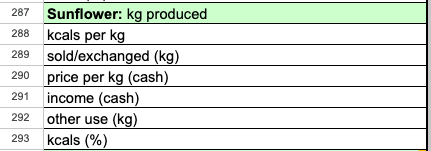
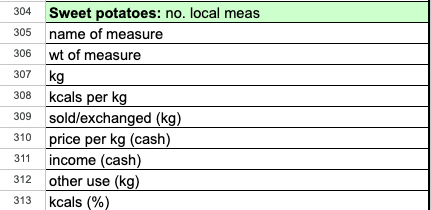
These are two examples from the same BSS. Each image shows one rowset where the first row is correctly labeled with the Product:Attribute format.
Use standardized product/crop names
The labels used in column A of the WB and Data sheets should use standardized and specific names and/or product codes where possible. The Livelihoods database uses a set of product codes based on CPC v2.1. Using a name and/or code from this list ensures that the correct item is associated with that data in the database.
Example: Cocoyam
Cocoyam can refer to a number of items including taro and yautia. Instead of using cocoyam in column A, use a more specific identifier such as 01550 Taro or 01591 Yautia.
Distinguish between raw products and processed products where needed
Some products require distinctions between raw product and product that is consumed. Each code begins with a one-character alpha-code prefix that FEWS NET uses to split its product and service codes into 4 distinct sub-groups.
-
R: raw, un-processed agricultural product
-
L: animal/livestock product
-
P: manufactured or processed product
-
S: service product
Example: Coffee and Rice
-
Coffee: Coffee for crop production (e.g., coffee cherry, green coffee bean) uses R01610 and differs from coffee for expenditure/purchase (e.g., roasted or ground bean) which uses P23911 - P23914.
-
Rice: Paddy rice (referring to what is produced) uses an R code and differs from husked rice (referring to what is purchased) which uses a P code.
Links to other cells should not be used in lieu of a name
Links are not a good substitute for specific names as they are not readable by the database and can cause errors.
Example: Main cereal
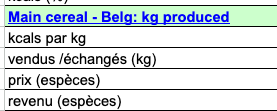
In the BSS pictured below, column A is labeled as Main cereal - Belg: kg produced and is linked to another cell in the spreadsheet. This should instead use a specific product name/code and attribute, such as Maize:kg produced.
Column A should explicitly state the expected data values for the row
If data is expected in the row, then the label in column A should explicitly state what data is expected.
Example: Bambara nuts
If the expected data is the number of local units purchased, use bambara nuts: no. local meas.
If the expected data is the amount produced, use bambara nuts: kg produced.
This avoids the ambiguity inherent in labels such as Other Crop Type: bambara nuts, where it is unclear whether the values represent the amount in kg, the number of local measures, or just a label where no additional data is expected.
Metadata should only be in column A
Don’t put information describing the livelihood strategy (metadata) in the per-community columns (column B onwards). For every row, the numbers for each community must refer to the same Livelihood Strategy. If the strategy refers to a particular type of food, then it should be the label in Column A, not in that row in Column B.
For example, the following data:
|
WEALTH GROUP |
V.Poor |
V.Poor |
V.Poor |
|---|---|---|---|
|
WILD FOODS |
termites |
|
termites |
|
Wild food type 1 - kg gathered |
2 |
|
10 |
Should properly be entered as:
|
WEALTH GROUP |
V.Poor |
V.Poor |
V.Poor |
|---|---|---|---|
|
WILD FOODS |
|
|
|
|
Termites - kg gathered |
2 |
|
10 |
Notice that “termites” has been moved from the community cells (columns B and D) to the label in column A. If the communities in the BSS gathered several different types of wild food, a row would be added for each food.
Data should not be stored in label rows
Do not put data values, including 0, in columns B onward on rows where the value in column A is a heading or other label not associated with expected data (e.g. the Wild Foods row in the example above). The BSS ingestion will refuse to load a BSS containing data in unexpected locations to ensure that no important data is lost.
This sometimes happens when the previous Livelihood Activity contained a 0 entry for many rows and they have been copied down one row too far, into the heading for the next section of the BSS.
Use zero purposefully
Only use zero when there is an opportunity for earning money, kcal, etc. If there is no opportunity, leave the cell blank. For example, labor should be left blank for kcal unless the field contains kcals from payment in kind.
There is one exception to this recommendation. In general, if the only values entered from any community for an activity are zero, it is better to leave all of the community values blank for that activity so that the system does not to create a product for which the only data is zero.
Example
If all of the communities in a BSS would report 0 for Other crops - kg produced, it would be preferable to leave those entries null (blank) rather than create the baseline entry for Other crops - kg produced with only entries of 0 kg.
Green consumption
Green consumption should be reported in months, not weeks. Note that there are 4.3 weeks in a month, according to the HEA field guide, so 1 week = 1/4.3 months or .23 months.
Add rows to the green consumption section if necessary to capture green consumption of each crop individually. In keeping with the spirit of the CPC 2.1, crops consumed green will use a different product code than the main crop. For example, regular maize is R01122, but green maize is R01290HA.
Payment in kind
When documenting payment in kind, there are two types of products involved:
-
The labor that is performed is the
product. -
The item that was provided in exchange for the labor is the
payment_product.
The kcals per unit for the payment_product are used to calculate/validate the kcals provided by the Livelihood Activity.
The first row of the Livelihood Activity in the BSS should contain the product. The payment_per_time label should specify the exact food item that was provided.
Example labels for column A are as follows:
|
English Label |
French Label |
Notes |
|---|---|---|
|
Pre-Harvest Labour: weeding |
Travail Pre-Récolte: sarclage |
The product should be in the label in column A, not in the per Community / Wealth Group responses in columns B onwards. The label should contain only one separator (typically a colon) with the first part being a broad category, such as Pre-Harvest Labor, and the second part being a more detailed activity, such as Weeding. |
|
no. people per HH |
nbr personnes par ménage |
|
|
no. times per month |
nbr fois par mois |
|
|
no. months |
nbr mois |
|
|
payment in kg per time (sorghum) |
paiement en kg par fois (sorgho) |
Use the common name for a specific product, such as sorghum or maize, rather than a generic term such as grain. |
|
kcals (%) |
kcals (%) |
|