
Preparing Acute Food Insecurity Area-level Classification data
The Integrated Food Security Phase Classification (IPC) data template can be used to create multiple Data Collections from one upload.
Acute Food Insecurity Classifications (AFIC) should be entered on the first tab of the Excel file. Use additional tabs for Humanitarian Food Assistance (HFA) and Internally Displaced People (IDP) data as applicable. The IDP tab captures both AFIC and HFA data for IDP camps.
FDW automatically creates separate Data Collections for AFIC and HFA data when you upload the file using the Add a new Data Collection and Offline Data Upload options.
The first month in the data collection period includes the CS (current situation), ML (near term projection of three months), ML2 (medium term projection of six months). The Outlook Collection Date in cell B3 is the first date from the current state through four months. A new collection date begins after four months.
Template guidelines
For all IPC-compatible data, cell B1 should indicate IPC v3.1. If the data you are uploading is IPC-aligned rather than IPC-compatible, the scale shown in cell B1 should be AIPC v3.1.
Use the dropdown boxes in row 1 to indicate the type of report, and the dropdown boxes in row 2 to indicate if there was a change in data from the previous month.
FDW pulls the values from the report type columns (e.g., FSO, KMU, FSOU) rather than from the ArcGIS section.
Enter data into the spreadsheet using the guidelines below.
Metadata requirements
Ensure all required metadata is populated:
-
All tabs should include the FNID and CN/Country with ISO 3166-1 alpha-2 two letter code.
-
AFIC and HFA tabs should include ADMIN1, plus ADMIN2, LZCODE, and LZNAME columns as applicable. The HFA tab should also include long and lat columns.
-
The IDP tab should include LOC_EN, columns for X and Y coordinates, SOURCE, and REGION.
Data entry requirements
Ensure that the entire IPC Phase, HA, and HFA columns for your target month is populated with data. There should be no blank cells.
IPC Phase values
Take note of the following when preparing IPC Phase values:
-
Enter 99 for no data. FDW will map the area in gray.
-
Enter 88 to map the national park symbology (Malawi, Uganda, Zimbabwe).
-
To include a modified phase description, replace the phase number in the report columns (FSO, FSOU, FSA, or KMU) with the description as written in the table below. You do not need to adjust the data in the ArcGIS Mapping columns.
|
Phase |
Description |
|---|---|
|
3 |
“Crisis,” “Crisis & risk of famine” |
|
4 |
“Emergency,” “Emergency & risk of famine,” “Famine possible,” “Emergency (outcomes may be worse)” |
|
5 |
“Famine,” “Famine Likely,” “Famine possible,” “Famine with reasonable evidence,” “Famine with solid evidence” |
HA values
HA column data controls the exclamation points that indicate if outcomes would likely be at least one phase worse without current or planned humanitarian food assistance.
Take note of the following when preparing HA values:
-
Enter 1 in the HA columns if you need to indicate that the Phase would be at least one Phase worse without anticipated food assistance. Otherwise, enter 0.
HFA values
HFA column data controls the wheat bags that indicate if at least 25 percent of households receive on average over 50 percent of caloric needs through HFA.
Take note of the following when preparing HFA values:
-
Enter NC in the HFA columns to indicate HFA has not been assessed and NA to indicate that there is no significant HFA available.
-
Use 0 in the HFA columns only to indicate that < 25% of the population are dependent on food aid.
Internal data
Separate Source Documents designated as FEWS NET/USG Only must exist in FDW before uploading internal data.
The naming convention for the Acute Food Insecurity Classifications Source Document is [Report type] (FEWS NET/USG Only), [Country], for example Food Security Outlook (FEWS NET/USG Only), Afghanistan. The naming convention for the Humanitarian Food Assistance Source Document is [Report type] (FEWS NET/USG Only) (HFA), [Country], for example Food Security Outlook (FEWS NET/USG Only) (HFA), Somalia.
Food Security analysts should coordinate with the DST Data Management Advisor and Senior GIS Specialist to add new Source Documents.
When preparing a file for internal IPC data, the column headings must specify that the data is internal (for example, FSO Internal rather than FSO). This is necessary for FDW to determine the correct Source Document to use for the data.
Remote monitoring data
Data for all remote monitoring (RM) countries are included on the RM data template. Remote monitoring data cannot be uploaded unless mapping data is filled in for all countries listed in the sheet. This file should not be uploaded for individual countries.
Uploading acute food insecurity area classification data
The options for uploading data using the Add a new Data Collection, Offline Data Uploads, and Import Acute Food Insecurity Phases screens are described below.
Data collections should be uploaded one month at a time.
Add a new Data Collection
Use Add a new Data Collection when uploading a small number of Data Collections as it provides immediate feedback on the success of the upload. Small Data Collections may upload within 1 minute, while the upload time for larger Data Collections, such as Ethiopia, may be 20+ minutes.
To access the Add a new Data Collection screen, go to Data Entry > Add a new Data Collection (manually or by uploading a file).
Complete the following steps:
-
Source Document: Select the Source Document that matches the data to be uploaded. For example, when uploading November 2025 data, you will select the Key Message Update Source Document for that country.
-
Collection Date: Use the first date of the report month. For example, 2025-10-01 for the October 2025 FSO, and 2025-11-01 for the November 2025 KMU.
-
File: Select the completed template for that country and month.
-
Select Save.
-
Save will populate the data uploaded with each numerical value representing one data point.
-
After the upload successfully completes, you will see the Humanitarian Food Assistance and Acute Food Insecurity Classification Data Collections listed on the Data Collections screen (Data Processing > Display or edit an existing Data Collection).
Offline Data Uploads
Use Offline Data Uploads when uploading a large number of data collections to save time and protect against errors due to loss of connectivity.
To access the Offline Data Uploads screen, go to Data Entry > Offline Data Uploads and click the Add data upload button.
Complete the following steps:
-
Click Choose File and select the file.
-
Import format: Select the format of the file you have selected.
-
Subtype: Select Acute Food Insecurity Phase.
-
Country: Select the country name.
-
Click Save.
The Offline Data Uploads screen will list the upload with a status of Processing. You will receive an email notifying you of the outcome of your upload. Once successfully uploaded, you will see both the Acute Food Security Phase and Humanitarian Food Assistance uploads listed.
In a situation where you need to upload HFA data separately, ensure it is moved to the first tab of the file and select Humanitarian Food Assistance as the Subtype.
Import acute food insecurity phases
You can use the Dataseries Management module to import Acute Food Insecurity Phase Data Points. Acute Food Insecurity Classification Data Series will be implicitly created when adding the Data Points.
There are several important considerations when using this option:
-
You must remain on the page until the upload is confirmed. As this may take several minutes, this method is only recommended for smaller Datasets.
-
HFA data cannot be uploaded at the same time as the Acute Food Insecurity Phases. To upload HFA data using this method, go to Data Series management > Data Points > Humanitarian Food Assistance.
To access the Acute Food Insecurity Phase import screen, go to Data Series Management > Data Points > Acute Food Insecurity Phases.
Complete the following steps:
-
Click Import Acute Food Insecurity Phases.
-
Select the file to import and the file format.
-
Click Submit.
The system will check which Collection Periods currently exist in FDW and create ones which do not. The system will also update existing data in FDW if the file contains changes.
Reviewing and publishing acute food insecurity area classification data
Reviewing data
Open the AFIC Data Collection by clicking the title. There should be a Collection Period for each scenario in the Collection Periods table.
Click the Edit button for each Collection Period and review the data.
If the data is correct, update the status of the Data Collection to Submitted. Repeat the review process for the HFA Data Collection.
Correcting data
You can upload a corrected file using the Change Data Collection screen if your data is in draft or Under Review status. Note that the date shown in the Status Changed column only refers to a change in the Data Collection Status in FDW, and does not reflect when the data was uploaded.
However, in many cases it is preferable to delete the existing Data Collections before re-uploading the data. For example, when AFIC data was uploaded but the HFA data was not successful.
Make corrections using the following steps:
-
Change the status of the Data Collection(s) to Under Review.
-
If your file has HFA data, change both HFA and AFIC Data Collections to Under Review.
-
-
Delete the Data Collection(s).
-
Upload the updated data.
-
Review and publish the Data Collection(s).
Visualizing submitted data
Once your data is in submitted status, you can create an Acute Food Insecurity Map in the FEWS NET Data Explorer (FDE) as part of your review. Only FDW users with the necessary permissions can create and view visualizations with submitted data. For detailed information on building the Acute Food Insecurity Map, visit the FDE Knowledge Base.
Make sure the status of the Data Collection has successfully updated in FDW before building a visualization to avoid caching issues.
Publishing data
To publish the data:
-
Go to Data Processing > Display or edit an existing Data Collection (including Submit, Review and Publish) and select the Data Collection you just created.
-
To filter your search, use the available dates at the top of the page and in the Filter sidebar select Acute Food Insecurity Classification. To filter for HFA data, select Humanitarian Food Assistance.
-
-
Open the Data Collection by clicking the title. Review the Data Collection and Collection Periods added.
-
To submit the data, click the Submit button.
-
To publish the data, open the Data Collection again and click the Publish button.
-
If you realize that the Data Collection was not ready for publishing, you can click the Review button to change its status to Under Review.
If you upload HFA data alongside AFIC data, remember to review and publish both of the Data Collections. HFA data should be published even if only 0s are reported.
Deleting cached objects
The Delete cached objects option is available from the Data Collection admin screen for select DST staff, including Deputy Decision Support Advisors and Senior Food Security Analysts.
The review and publish options also result in the cache being deleted. If you have successfully changed the status to Under Review or Published, and there are no further changes to the data, then choosing the delete the cache will have no impact.
To delete the cache for one or more Data Collections:
-
Select the Data Collection(s) from the table.
-
Under the Action dropdown, select Delete cached objects.
-
Click Go.
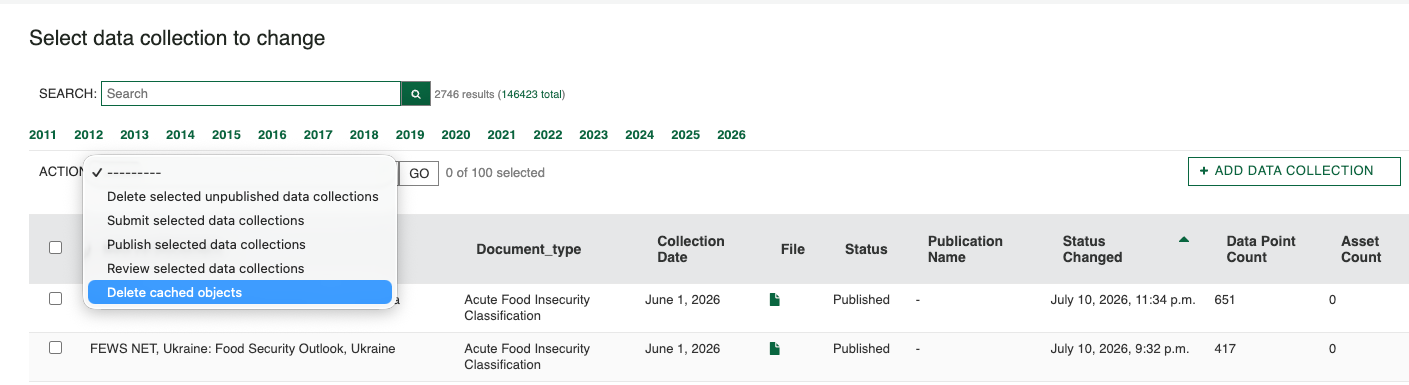
A green confirmation banner will appear at the top of the page once the cached objects are successfully deleted. Do not reload the page while the request is being processed. Do not try to delete the cache multiple times in a row, as the system will only respond to the first request.